
Religious ‘nones’ would outnumber Protestants among young people in ‘small town’ America: Pew
December 1, 2025
A new report from the Pew Research Center examines the question of whether Christianity would dominate the U.S. if the nation were reimagined as a small town of 100 people.
The Christian Post reports that Pew’s sweeping 2023-24 Religious Landscape Study (RLS) took place from July 17, 2023 to March 2024, surveying nearly 37,000 U.S. adults.
The study reports that, with a population of roughly 262 million adults, Christianity has roughly 162 million adherents while 76 million have no religious affiliation.
The study acknowledges that, with such huge numbers, getting a feel for the religious landscape can be daunting while asking, “But what if we imagined the U.S. as a small town of 100 people instead of a country with hundreds of millions of people?”
According to Pew, in that specific scenario, religious “nones” who identify as atheist, agnostic or “something else” would outnumber Protestants among young people.
Breaking down the small town scenario further, Pew reports that Christians would still hold a clear majority of 62 out of 100, including 23 Evangelical Protestants, 19 Catholics, 11 mainline Protestants, and five individuals tied to historically Black Protestant denominations.
According to the Christian Post, the report included other groups that identify as Christian including two members of the Church of Jesus Christ of Latter-day Saints (Mormons) and two more from other groups, including Jehovah’s Witnesses and smaller sects.
Nearly a third of the town’s residents would be “nones” with 29 of the residents claiming that status.
Meanwhile, non-Christian faiths would round out the town’s population with seven people: two Jewish, one Muslim, one Buddhist, one Hindu and two representing a mosaic of other beliefs, from Baha’is and Sikhs to Wiccans.
The study also dives into other demographics, including age, gender and race.
Overall, the Pew study tends to align with other studies showing younger adults in the U.S. are more likely to be religiously unaffiliated than their older counterparts.
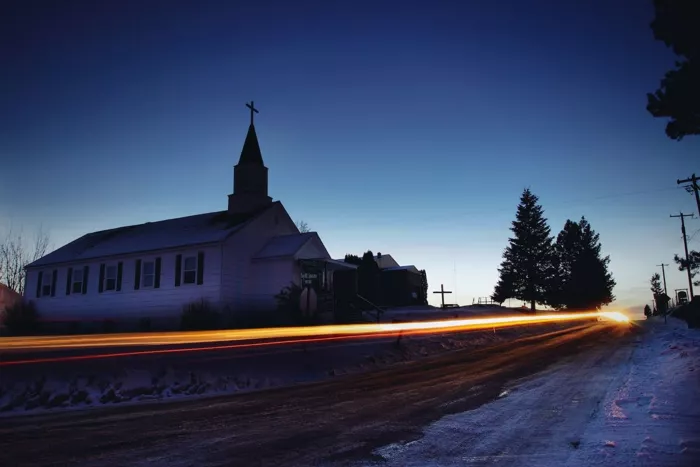
Photo: top, Credit: Unsplash/Timothy Eberly