
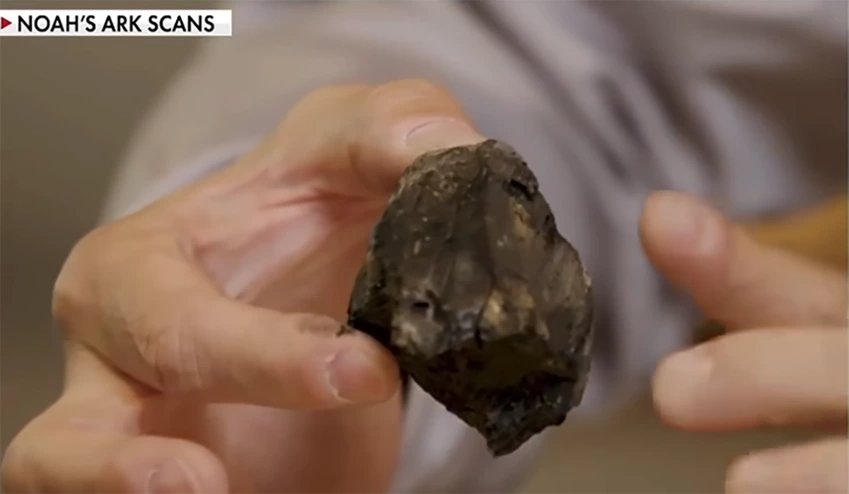
Noah’s Ark researcher says wood samples found in Turkey align with Genesis flood timeline
November 23, 2026
A researcher who leads a search for Noah’s Ark at a boat-shaped formation in the mountains of Ararat in Turkey, says radiocarbon tests on two charred wood samples from the site returned dates that line up with the flood recounted in the Book of Genesis.
The Christian Post reports that Andrew Jones told Fox News on Saturday that his team dated one sample to between 2456 and 2203 B.C. and the other to between 2446 and 2143 B.C.
The team’s graphic gives two proposed dates for the flood, 2348 B.C. and 2304 B.C., and both fall within each sample’s range. That overlap is the basis for Jones’s statement that the results match the biblical timeline.
The Jerusalem Post reported that Jones confirmed that blackened fragments resembling charred wood had turned up deep inside the formation, known as Durupinar.
According to the Christian Post, Cenker Atila, a classical archaeologist at Sivas University in Turkey who is president of the group’s research project, discovered the fragments.
In a video posted to social media, Atila stated that the pieces lay roughly nine meters (30 feet) underground on the southern slope.
“One of the wooden pieces clearly shows signs of human workmanship,” he said, adding that its surface looked slightly flattened with an axe or knife.
Turkish authorities gave the group and Atila permission to begin core drilling at the site in July.
On its website, the group puts the formation’s length at 157 meters (515 feet), a figure it equates with 300 Egyptian royal cubits.
Genesis 6:15 gives that as the ark’s length, and the group adds that the ratio of width to length falls within the range in the biblical account.
Photo: top, Credit: Screengrab/Noah’s Ark Scans