
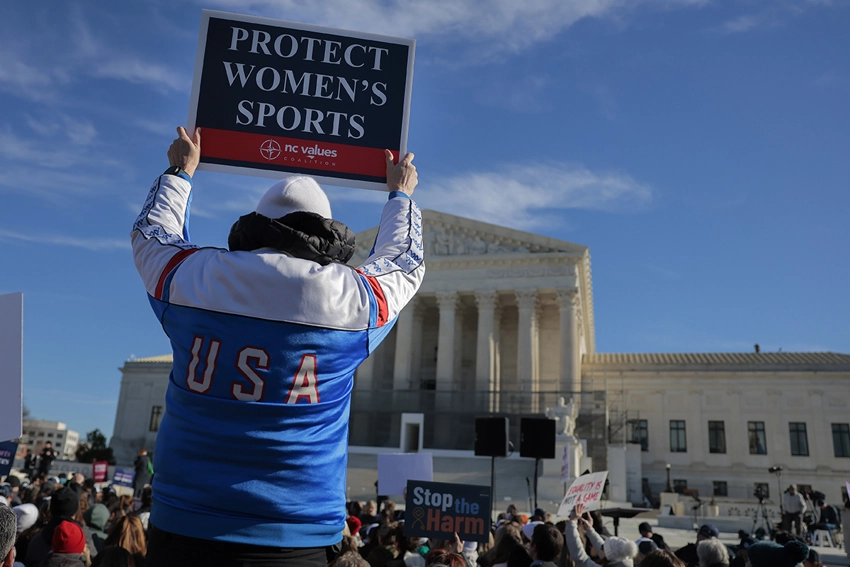
Attorneys arguing against ban on trans-identified male athletes in girls’ sports at Supreme Court refuse to define ‘sex’
January 14, 2026
The U.S. Supreme Court heard oral arguments on Tuesday in two related cases, Lindsay Hecox et al. v. Bradley Little, et al. and State of West Virginia v. B.P.J.
The Christian Post reports that attorneys who argued against the state laws prohibiting male athletes from competing in girls’ sports refused to fully define the term “sex” when arguing their cases before the Supreme Court.
The Hecox case revolves around a trans-identified male athlete suing to strike down an Idaho’s Fairness in Women’s Sports Act.
That state law was blocked by a three-judge panel of the Ninth U.S. Circuit Court of Appeals in August 2023, upholding a lower court preliminary injunction against it.
Meanwhile the B.P.J. case involves a challenge by another trans-identified male athlete to West Virginia’s Save Women’s Sports Act of 2021.
A three-judge panel of the Fourth U.S. Circuit Court of Appeals issued a 2-1 decision in February 2023, reinstating an earlier lower court ruling that blocked enforcement of the law.
According to the Christian Post, Justice Samuel Alito asked Kathleen Hartnett, who represented Lindsay Hecox, if she agreed that a school could have “separate teams for a category of students classified as boys and a category of students classified as girls?”
When Hartnett responded affirmatively, Alito then asked, “Is it not necessary for there to be, for equal protection purposes, if that is challenged under the Equal Protection Clause, an understanding of what it means to be a boy or a girl, or a man or a woman?”
Once again Hartnett said, “Yes, your honor.”
However, when Alito then asked “what is that definition” for boy and girl “for equal protection purposes,” Hartnett responded, “We do not have a definition for the court.”
Hartnett added, “We’re not disputing the definition here. What we’re saying is that the way it applies in practice is to exclude birth-sex males categorically from women’s teams.”
Alito then responded, “How can you, how can a court determine whether there’s discrimination on the basis of sex without knowing what sex means, for equal protection purposes?”
By the end of the day’s arguments, a majority of justices appeared to be leaning toward upholding the state laws.
A ruling isn’t expected until June and could affect as many as 27 states.
Photo: top, Credit: Heather Diehl/Getty Images